
Furosemide CRIs for Acute Congestive Heart Failure: Protocols, Pitfalls, and Practical Advice
Why Choose a Furosemide CRI?
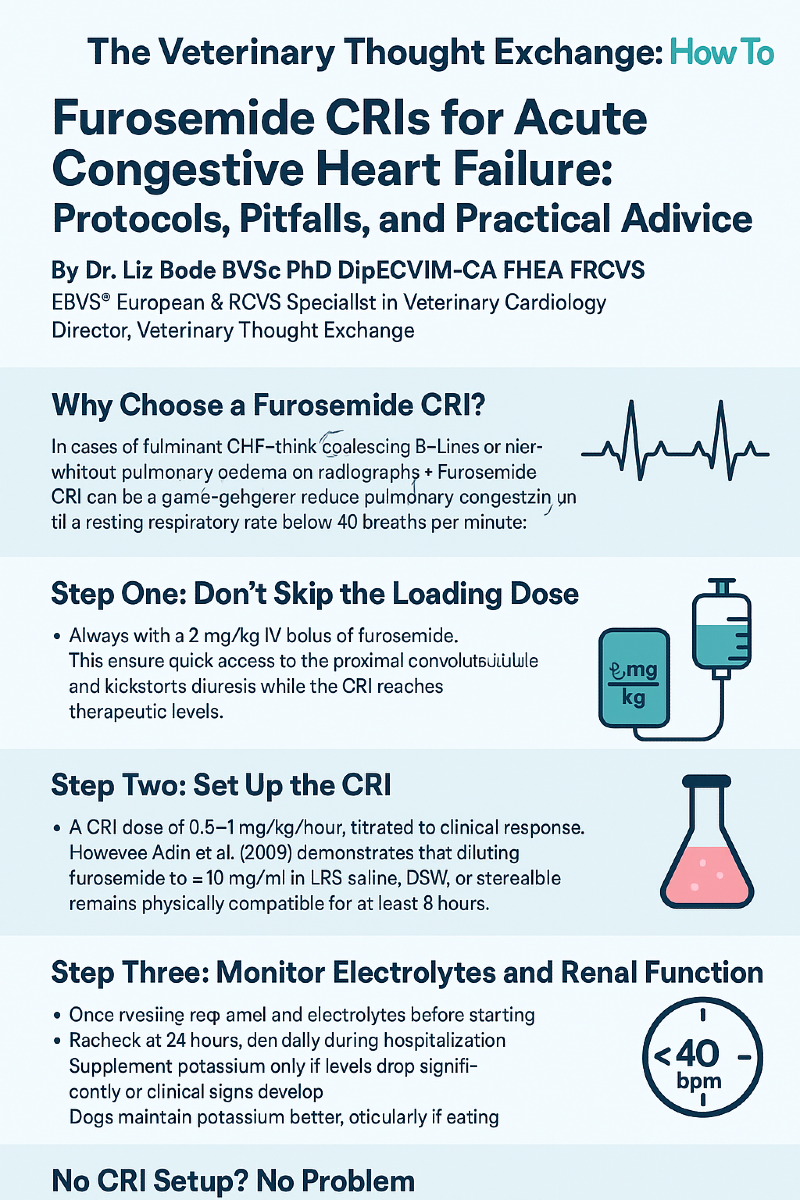
I typically reserve a furosemide CRI for fulminant heart failure, such as when thoracic radiographs show a near-whiteout or POCUS reveals coalescing B-lines. The primary goal is to reduce pulmonary congestion until the resting respiratory rate (RR) falls below 40 breaths per minute. At that point, the CRI is stopped, and I’ll transition to boluses or oral medication depending on the clinical picture.
Multiple studies support the use of CRIs in this setting. A 2019 study by Ohad et al. suggested not only a superior diuretic effect in the early hours compared to intermittent boluses but also a trend toward shorter hospitalisation.
The Importance of a Loading Dose
A 2mg/kg IV loading dose is essential. This ensures that furosemide reaches the proximal convoluted tubule and exerts its effect quickly, especially since CRIs take time to achieve therapeutic plasma concentrations. Following this, I typically use a CRI at 0.5–1mg/kg/hour, tailored to patient response.
What About Dilution and Precipitation?
In my own practice, I administer the CRI via a syringe driver without dilution. That said, evidence from Adin et al. (2003) supports dilution of furosemide (up to 10 mg/ml) in lactated Ringer’s, saline, D5W, or sterile water, with no visible precipitation for up to 8 hours. This may offer flexibility depending on your set-up.
Managing Electrolyte Imbalances
Both CRIs and boluses can result in hypokalaemia, particularly in cats. I don’t routinely supplement potassium unless the animal becomes symptomatic or electrolyte values fall. Dogs often maintain potassium levels well, especially if eating. I recommend baseline renal and electrolyte checks before initiating diuresis and then rechecking 24 hours later and daily until discharge.

Why Not Just Stick With the CRI?
Interestingly, although CRIs offer better diuresis in the first 8 hours, data (mainly from equine models) suggest that intermittent boluses may become more effective thereafter. In practice, I often stop the CRI once the RR is stable and transition to bolus dosing to fine-tune fluid offloading and begin estimating an appropriate oral furosemide dose for discharge.
Clinical Protocol (Dog or Cat with Severe CHF)
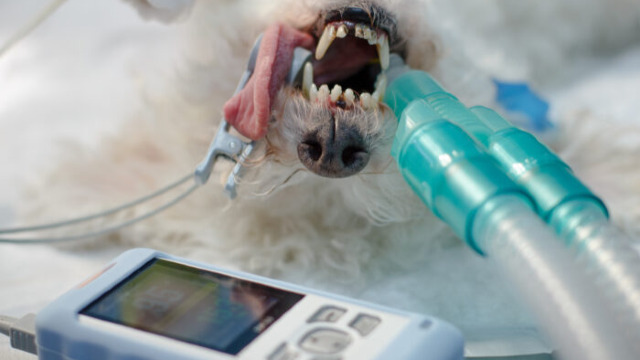
- Patient presents dyspnoeic and is stabilised in oxygen.
- Diagnostic imaging confirms pulmonary oedema (e.g. B-lines, enlarged LA).
- Administer 2mg/kg IV furosemide as a loading dose.
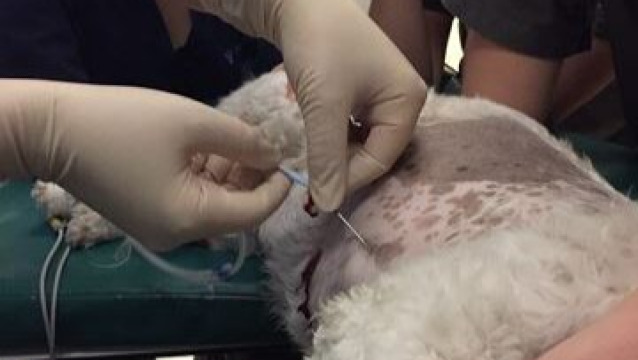
- Initiate a furosemide CRI at 0.5–1mg/kg/hr.
- Monitor RR hourly. Once RR is <40 bpm, discontinue the CRI.
- If RR remains stable:
- Transition to oral furosemide (e.g. 2 mg/kg TID initially), o
- Use intermittent boluses (e.g. 1 mg/kg IV q4–6h), guided by RR.
Don’t forget to monitor renal parameters and electrolytes at least every 24 hours and again one week post-discharge. In cats, take special care with potassium, and consider supplementation if needed.
What If You Can’t Use a CRI?
If a CRI setup isn’t available or the patient can’t tolerate a line, you can use bolus therapy effectively. Start with 2mg/kg IV, then give 1mg/kg q1–2h until RR improves. Adjust based on response, then taper to oral treatment once stable.
In Summary
Furosemide CRIs remain a powerful tool in the management of acute CHF, particularly in the critical first 8–12 hours. With careful dosing, monitoring, and thoughtful transition to bolus and oral therapy, we can effectively stabilise patients and guide them toward a safe discharge.
Dr. Liz Bode BVSc PhD DipECVIM-CA FHEA FRCVS
EBVS® European & RCVS Specialist in Veterinary Cardiology, Director, Veterinary Thought Exchange
References
- Ohad DG, Dvir E, Aroch I. Retrospective evaluation of continuous rate infusion versus intermittent bolus administration of furosemide in 66 dogs with left-sided congestive heart failure. J Vet Intern Med. 2019;33(3):1209–1216.
- Adin D, Cowgill LD, Dronsky M. Compatibility of furosemide with crystalloid intravenous fluids. J Vet Intern Med. 2003;17(1):56–60.
- Kurokawa T, Uemura T, Nakamura Y, et al. Comparative pharmacodynamics of continuous versus intermittent administration of furosemide in horses. J Vet Med Sci. 1999;61(11):1239–1242.

Comments
You need to be logged in to view and / or leave comments.
Login